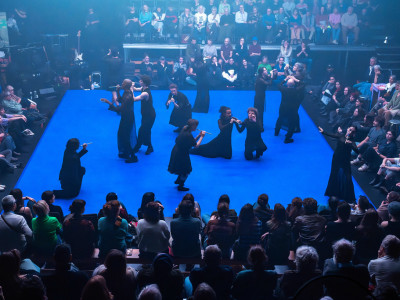
This was EUROPALIA ESPAÑA
In 2025, EUROPALIA celebrated its 30th edition with a large-scale Spanish biennial. Exactly forty years after the first Spanish edition in 1985, EUROPALIA ESPAÑA, from October 8, 2025, to February 1, 2026, presented a multidisciplinary program that united heritage and contemporary art forms and offered fascinating perspectives on themes that connect and challenge us.
With Francisco de Goya as its starting point and source of inspiration, this festival highlighted Spain’s cultural richness in the visual arts, architecture, theater, dance, music, performance, film, and literature, featuring both well-known and lesser-known names. The artistic teams from both countries deliberately selected artists from different generations, who came not only from major cities like Madrid and Barcelona, but also from all corners of Spain.
Forty years after the first edition, EUROPALIA ESPAÑA was an ideal occasion to focus on the changes Spanish society has undergone since the advent of democracy and membership in the European Union in 1986, and to highlight the artistic creation of the past four decades.
GOYA: A CENTRAL FIGURE
The festival kicked off with the main exhibition Luz y sombra. Goya and Spanish Realism at Bozar (Brussels), which ran from October 8, 2025, to January 11, 2026. The exhibition was built around one of the great masters of Spanish art, whose modern sensibility is more relevant today than ever. Goya (1746–1828) is known for his impressive portraits and colorful genre scenes. His oeuvre is also characterized by socially critical images, including denunciations of war and the general abuses of his time.
The exhibition invited reflection on Goya’s work from a contemporary perspective. Goya and the “Goyesque,” with all their connotations of light and shadow, have become entrenched in the Western imagination since the 19th century as models, stereotypes of authentic Spanishness. This exhibition did not reject them, but used these clichés as a springboard and sought to identify the form and references of some of their basic patterns as a way to understand “Spanishness.”
Goya lived in a time of crisis, transformation, and paradigm shifts, with all the uncertainties and possibilities that entailed—perhaps a time not unlike our own. He captured the present, reflected his time, and created a mirror in which we continue to see ourselves, even though our times are different.
The exhibition brought together Goya’s paintings, drawings, and engravings with works by his contemporaries and by artists of subsequent generations (José Gutiérrez Solana, Pablo Picasso, Antonio Saura, among others). In addition, new multidisciplinary creations helped demonstrate the relevance of Goya’s oeuvre today. The ensemble of 250 works explored Goya’s legacy and the significance of his oeuvre in the perception of Spain.
CENTRAL THEMES: CAPRICHOS, DISPARATES, AND DESASTRES DE LA GUERRA
Caprichos, Disparates, and Desastres de la Guerra (Caprices, Follies, and Disasters of War) are the titles of three series of engravings and three terms that reflect Goya’s critical and visionary spirit, all of which inspired the EUROPALIA ESPAÑA program as a whole and made it possible to connect the past with the present and the local with the global. The series serve as sources of inspiration for viewing the present and exploring contemporary themes. How would Goya’s Caprichos, Desastres de la Guerra, or Disparates manifest themselves today? What are our whims, our follies, our disasters? These themes ran through the multidisciplinary festival, which took place across Belgium, in 14 cities with 71 artistic partners and in public spaces. In total, the festival reached more than 648,000 visitors.
Those visitors (re)discovered established artists from older generations, such as Juan Dominguez, Cuqui, Maria Jerez, La Ribot, Mal Pelo, and Esther Ferrer, as well as younger talents such as Nuria Guiu, Las Huecas, Elena Medel, and La Chachi. Some engaged in a dialogue with artists from Belgium or other countries to create new works, such as Suso Saiz with Echo Collective. But also the four Spanish dancers and musicians in the EUROPALIA format Pick-Up Club (in co-production with Charleroi danse) who had a blind date with four dancers and musicians living in Belgium. Or visual artist Sara García Fernández and the musical duo Tarta Relena, who, together with Belgian soprano Lore Binon, shaped the Rituales format for this edition.
The festival presented well-known names such as the Baroque music ensemble Cantoría, theater maker Angélica Liddell, pianist Javier Perianes, filmmaker Albert Serra, dancer Israel Galván, and design icon Patricia Urquiola (CID, Hornu), as well as deliberately lesser-known names, particularly in Belgium, such as filmmaker/designer Iván Zulueta and artists Marta Azparren, Esperanza Collado, and Elsa Paricio.
Together, these artists represent a multifaceted Spain and a multifaceted world, which EUROPALIA connected with a diverse audience, in collaboration with a rich network of partners.
“EUROPALIA ESPAÑA offered a unique opportunity to delve deeply into Spain’s cultural and artistic heritage while simultaneously reflecting on contemporary global issues through the lens of Goya’s work. By interweaving historical narratives with contemporary artistic expressions, the festival invited the public to explore the complexities of identity, community, and democracy in Spain and beyond. Beautiful connections and dialogues emerged, enriching our understanding of the past and hopefully inspiring future generations to continue the conversation.”
— Maral Kekejian & Dirk Vermaelen, artistic directors of EUROPALIA ESPAÑA
This program was co-organized by the Spanish Ministry of Foreign Affairs, European Union, and Cooperation, through AECID, with the significant collaboration of Acción Cultural Española (AC/E) and with the support of the Instituto Cervantes, the Ministry of Culture, and the Commission for the Celebration of 50 Years of Freedom in Spain, institutional partners of this event.