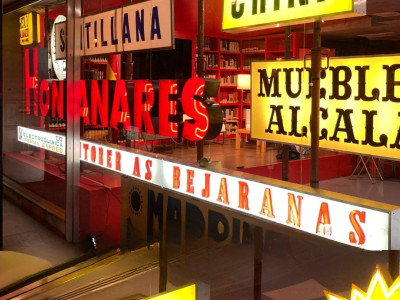
© Paco Graco
Paco Graco. Homelands
- –
- Institutio Cervantes, Brussels
PACO GRACO endeavours to protect and preserve Madrid’s commercial graphic heritage, which has faced significant threats recently. A living archive that protects, preserves, and publicizes signs from businesses that are being dismantled and demolished massively in recent years.
For three months, the facade of the Instituto Cervantes will house a collection of signs from bars and restaurants that have closed in recent years, recovering the words that end up being the places, or vice versa.
Zuloark is a distributed Architecture and Urbanism office founded in 2001 that is committed to social and collaborative work, not only among its members, but also with external collaborators. The organisation initiates and actively participates in processes that are relevant for different communities all around the EU with the idea of strengthening participatory processes and democracy. Currently, Zuloark is working on rethinking collaborative models in architecture in the face of globalised systems, preserving and sharing the intangible and social heritage of cities, and integrating recycling and second-life policies that contemplate the cycle of materials in design processes.
Each year, during its International Congress (Zulocongress), Zuloark meets to reflect and create collectively with collaborators and agents, both local and international, linked to the contexts in which they develop their work. Within the framework of EUROPALIA ESPAÑA, the collective will travel to Brussels to inhabit the Cervantes Institute, where it will propose a series of spatial interventions and a program of meetings, workshops, and talks. These activities seek to open their current questions to the city, connecting with the local ecosystem of spaces and people who share ways of working similar to those of the collective.
In collaboration with Comisionado 50 Años de España en Libertad